NASA / JPL · Deep Space Network · est. 1977
Voyager 1 The farthest human-made object — and where every photograph was taken on the long way out.
The journey, to scale
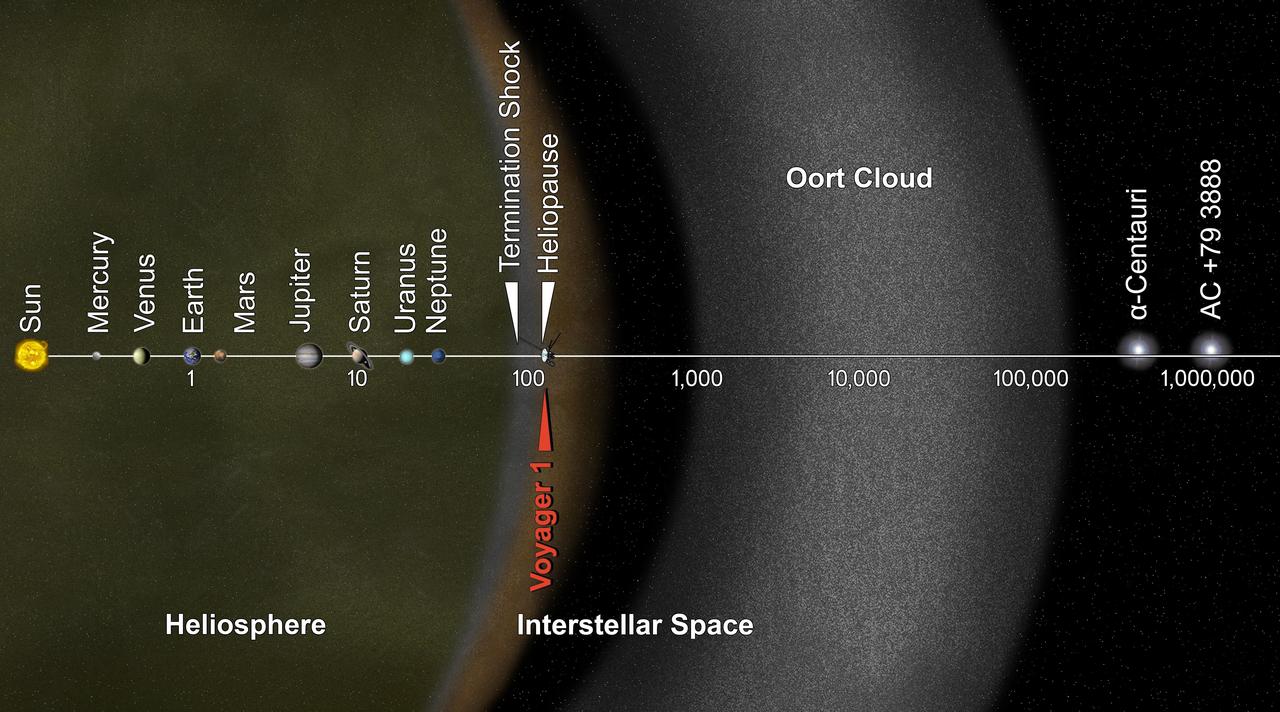
Forty-eight years, on a logarithmic axis
Distances in space defy a linear ruler. Plotted truthfully, the planets crowd into the first sliver and the rest of the chart is empty black. So this axis is logarithmic — each step to the right is ten times farther. Even then, notice how the boundary crossings of the last twenty years pile up against the right edge: that emptiness is the point.
Tick labels mark astronomical units (AU). 1 AU = the Earth–Sun distance ≈ 149.6 million km.

Liftoff from Cape Canaveral
A Titan IIIE-Centaur lifts Voyager 1 off Launch Complex 41 — sixteen days after its twin, but onto a faster track that will reach Jupiter first. The Centaur's second stage nearly ran dry, cutting off just 3.4 seconds short of empty.
It was built to survey two planets in five years. Forty-eight years later it is still calling home from interstellar space — outliving its design by a factor of ten.

Earth and Moon, together
Just thirteen days out, Voyager 1 turned its narrow-angle camera back home and captured the first image ever to show the Earth and Moon together in a single frame — a calibration shot that became a portrait.
A rehearsal for the giant planets ahead — and an early hint of Voyager's gift for the long look back.


Jupiter, up close
Closest approach: 348,000 km from Jupiter's center. Over a four-month encounter Voyager 1 returned 19,000 photographs, found a faint ring and two new moons — and made one of the great discoveries of planetary science: active volcanoes on the moon Io, the first ever seen beyond Earth.
Io rewrote the rulebook: small worlds can be geologically alive. The Red Spot resolved into a 300-year-old storm wider than Earth.


Saturn, and the gamble on Titan
Mission planners faced a fork: aim Voyager 1 at Pluto, or at Titan — Saturn's haze-shrouded moon. They chose Titan, skimming within 6,400 km. The cameras saw only featureless orange smog, but the other instruments read a thick nitrogen atmosphere denser than Earth's. That choice flung the spacecraft up and out of the planets' plane forever.
Titan's chemistry hinted at lakes of liquid methane — confirmed 25 years later by Cassini. With its planetary tour over, Voyager 1 became an interstellar probe.


The Pale Blue Dot
At Carl Sagan's urging, Voyager 1 turned around one last time and photographed home from 6 billion km — a 60-frame "family portrait" of the solar system. Earth fell across just 0.12 of a pixel, caught inside a scattered ray of sunlight. Thirty-four minutes later, the cameras were switched off forever to conserve power.
"That's here. That's home. That's us." The last photograph Voyager 1 ever took turned a calibration target into the most humbling image in spaceflight.
Crossing the termination shock
No more pictures — now the story is told in fields and particles. At 94 AU the supersonic solar wind slammed into the pressure of interstellar space and abruptly slowed below the speed of sound. Voyager 1 had entered the turbulent heliosheath, the outermost layer of the Sun's domain.
The first structural boundary of the solar system ever crossed — proof the Sun's wind has an edge.
Into interstellar space
At 121 AU, Voyager 1 crossed the heliopause — the boundary where the Sun's wind finally yields to the gas and magnetic field between the stars. The plasma density around the spacecraft jumped roughly fortyfold, solar particles fell away, and galactic cosmic rays surged. It was the first time anything built by humans had left the Sun's bubble.
A milestone for the species: the first emissary to reach the space between the stars. In 2018 it even heard the faint, steady drone of the interstellar medium.

Where it is at this second
Voyager 1 no longer adjusts course; it has coasted on the same heading since 1980. These figures are propagated live from its cruise velocity — the distance below is growing by about 17 kilometres every second as you read.
Only two instruments still run, sending data slower than a 1990s modem. Engineers power systems down one by one to keep the faint signal alive — a decades-long act of careful triage.
One light-day from Earth
In November 2026 Voyager 1 becomes the first object ever to sit a full light-day away — 25.9 billion km, the distance light itself covers in 24 hours. Say "good morning" on Monday and the spacecraft hears it Tuesday; its reply lands Wednesday. A two-day conversation across one sentence.
No spacecraft has ever been this far, and at Voyager 2's pace the record stands until at least 2035. Light leaves the Sun and travels a full day before it catches up.
After the signal fades
Sometime around 2036 the RTGs will no longer power even a single instrument, and Voyager 1 will fall silent. But it will not stop. With no drag and nothing to slow it, the spacecraft coasts on toward the constellation Ophiuchus — carrying the Golden Record, a gold-plated message of sounds and images from Earth, for whoever might one day find it.

Power runs out. The last instruments are switched off as plutonium decay drops the RTG output below the survival threshold. The mission ends; the flight does not.
The inner Oort cloud. Voyager 1 reaches the theorized shell of icy bodies that loosely surrounds the Sun — and will take roughly 30,000 more years to cross it. Only then is it truly free of the solar system.
A near pass of Gliese 445. The probe drifts within about 1.6 light-years of the faint red dwarf Gliese 445 in Camelopardalis — its first close encounter with another star.
Eternity. Statistically it could wander the Milky Way for longer than the present age of the universe before coming near anything at all — a silent ambassador, still carrying our message.